Build your own National Assembly
Set a vote share for each force and see how the Electoral Code turns it into seats — thresholds, minority mandates, the 52% stable-majority rule, coalitions and a second round.
Vote shares
Shift + arrows = ±1If no single force wins a majority, a coalition must be formed. The coalition forces must hold at least 52% of the mandates and agree on a prime-minister candidate. Under the Electoral Code, the right to form a coalition first goes to the force in 1st place. If it fails to form a coalition within the set 9-day period, that right passes to all the other forces. If they too fail within 5 days to form a coalition with 52% of the votes and a PM candidate, a second round of elections is held. Choose one of these scenarios.
Led by CC
First right to form a coalition · 9 days
Without the leader
The other forces · 5 days
Second round
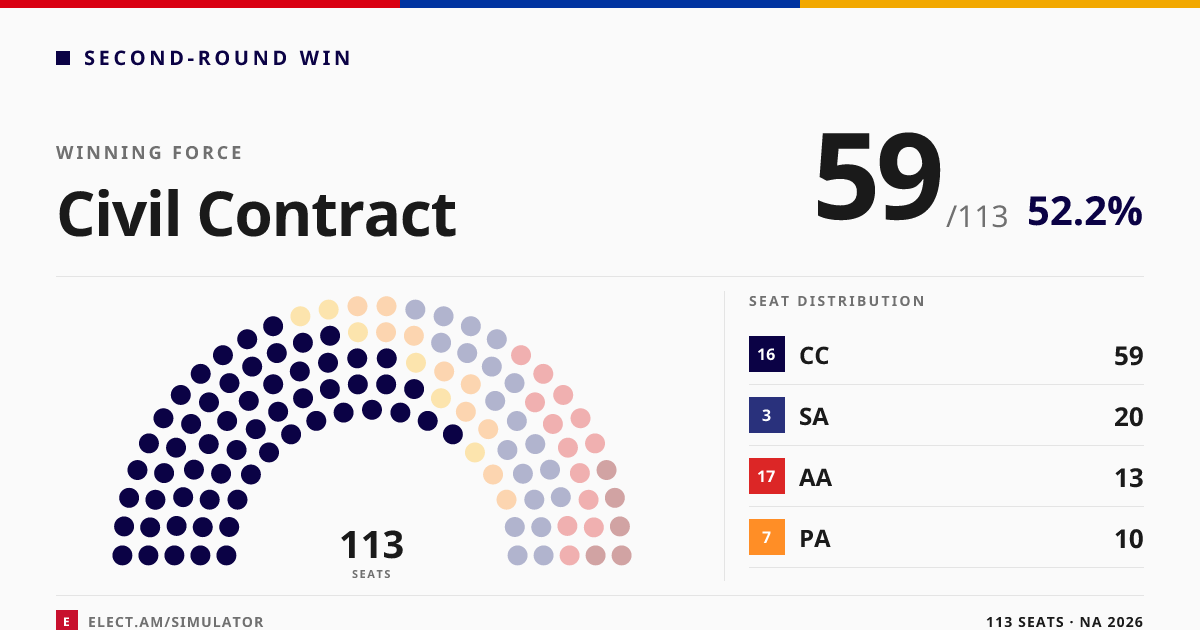
The second round is held on the 35th day after voting day (Electoral Code, art. 98). The two leading forces or coalitions compete; the winner is given a stable-majority margin (topped up to 52% of the seats).
Clearing the threshold
The following forces cleared the 4/8/10% threshold of the sum of valid ballots cast and the number of inaccuracies:
- Civil Contract, Prosperous Armenia, Wings of Unity and Democracy Law Discipline parties: 4% threshold
- Strong Armenia Alliance and Armenia Alliance alliances: 8% threshold (made up of 2–3 parties)
Base mandates (101)
The 101 base mandates were distributed among the forces that cleared the threshold, in proportion to the votes they received (RA Electoral Code, art. 95, parts 5–6). Each force's ballot count was multiplied by 101 and divided by the total votes of all forces that cleared the threshold; the integer part of the quotient is that force's first share of mandates. The mandates remaining up to 101 were distributed in order of largest remainder, one mandate to each in turn.
- Civil Contract — 48 mandates (40.30% votes)
- Strong Armenia Alliance — 19 mandates (16.47% votes)
- Armenia Alliance — 13 mandates (11.31% votes)
- Prosperous Armenia — 10 mandates (8.40% votes)
- Wings of Unity — 6 mandates (4.86% votes)
- Democracy Law Discipline — 5 mandates (4.23% votes)
National-minority mandates (4)
Four mandates are distributed among national-minority representatives — one each to the four national minorities with the largest permanent population per the last census before the elections (Yezidi, Russian, Assyrian, Kurdish) (RA Electoral Code, art. 95, part 9). The mandates are distributed among the forces that cleared the threshold by a coefficient computed for each mandate: C = M / (Aw + 1), where M is the number of mandates the force won from the main part of its list and Aw is the total it has already been awarded out of the four minority mandates. Mandates are distributed in order of decreasing coefficient, and each one goes to the national minority with the lowest list position not yet awarded a mandate. Steps:
- Yezidi → Civil Contract (M = 48, Aw = 0; C = 48/1 = 48.00)
- Russian → Civil Contract (M = 48, Aw = 1; C = 48/2 = 24.00)
- Assyrian → Strong Armenia Alliance (M = 19, Aw = 0; C = 19/1 = 19.00)
- Kurdish → Civil Contract (M = 48, Aw = 2; C = 48/3 = 16.00)
Second-round additional mandates (+8)
The second-round winner's additional-mandate rule was applied (RA Electoral Code, art. 98, part 6, under the procedure of art. 96). The second-round winner, Civil Contract, had received less than 52% of the total mandates in the first round, so it was granted enough additional mandates to bring its total share to no less than 52%.
- Civil Contract — +8 additional mandates
| Force | Vote % | Base | Min. | Add. | Total | Share | |
|---|---|---|---|---|---|---|---|
| 16Civil Contract party | 40.30% | 48 | 3 | +8 | 59 | 52.2% | |
| 3Strong Armenia Alliance alliance | 16.47% | 19 | 1 | 0 | 20 | 17.7% | |
| 17Armenia Alliance alliance | 11.31% | 13 | — | 0 | 13 | 11.5% | |
| 7Prosperous Armenia party | 8.40% | 10 | — | 0 | 10 | 8.8% | |
| 6Wings of Unity party | 4.86% | 6 | — | 0 | 6 | 5.3% | |
| 15Democracy Law Discipline party | 4.23% | 5 | — | 0 | 5 | 4.4% | |
| Total | 113 | 100% | |||||